
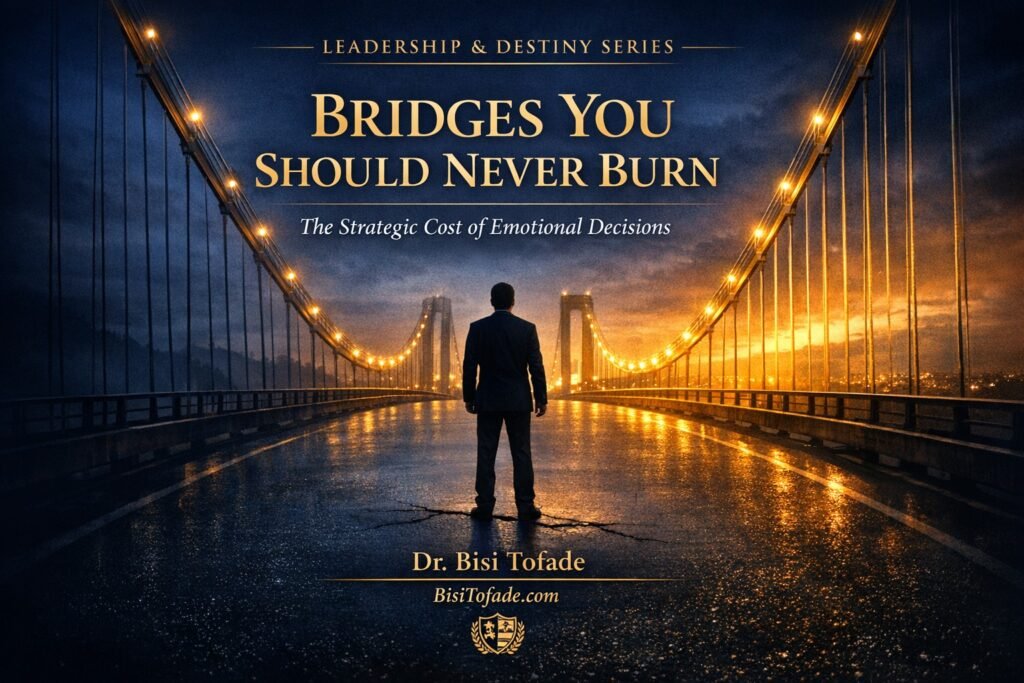
Strategic introduction
In leadership, ministry, entrepreneurship, governance, and destiny advancement, relationships are infrastructure.
You can lose money and recover. You can lose position and regain it.But when you burn the wrong relational bridge, you can delay your destiny by years. Many leaders do not fall because of incompetence. They fall because of reaction. A harsh email. An unguarded statement. An ego-driven exit. A public offense. A silent grudge.
And the bridge collapses.
In Scripture, bridges were often more important than platforms. David’s bridge to Saul preserved his future. Joseph’s bridge to his brothers positioned national salvation. Ruth’s bridge to Naomi opened generational royalty.
The wise leader understands this principle:
Not every bridge is meant to be crossed again — but some bridges must never be burned.
This article is about discernment, maturity, and relational intelligence.
THE ARCHITECTURE OF DESTINY BRIDGES
Every major life advancement comes through people. Investors. Mentors. Gatekeepers. Recommenders. Spiritual covering. Institutional sponsors. Strategic alliances.
Even Jesus operated relationally.
• He called disciples. • He sent them in pairs.
• He restored Peter. • He maintained covenant bonds.
Destiny is rarely solitary.
Bridges represent:
• Access • Trust capital • Institutional memory • Spiritual alignment
• Future leverage
When you burn a bridge, you do not just end a relationship.
You close access to:
• Networks • Opportunities • Credibility •Referrals • Future reconciliation
Leaders who rise sustainably understand relational infrastructure.
WHY LEADERS BURN BRIDGES
Bridge destruction is rarely strategic. It is emotional.
- Offense
Offense convinces you that cutting someone off equals strength. But unresolved offense corrodes judgment. - Ego
Ego says, “I don’t need them.” Destiny often whispers: “You may need them later.” - Impatience
Impatience misinterprets delay as rejection.
Many bridges are burned in seasons of misunderstanding. - Public Confrontation Instead of Private Conversation
Proverbs 18:19 reminds us: “A brother offended is harder to win than a strong city.” Public dishonor creates fortified walls. - Misreading Seasons
Not every transition requires destruction.
Sometimes it requires distance without damage.
Strategic exit is different from emotional explosion.
BIBLICAL CASE STUDIES IN BRIDGE MANAGEMENT
- David and Saul (1 Samuel 24)
David had opportunity to eliminate Saul.
He did not. He protected the bridge — even when Saul was toxic.
Why? Because David understood divine order and long-term consequence. He preserved moral credibility. - Joseph and His Brothers (Gen 24)
Joseph had power to retaliate. Instead, he restored.
That restoration preserved:
• Family lineage • National survival • Prophetic destiny.
Sometimes reconciliation expands legacy. - Paul and Barnabas (Acts 15)
They disagreed sharply.
They separated strategically.
But they did not launch public character assassination.
Separation without destruction.
That is maturity.
WHEN YOU SHOULD NOT BURN A BRIDGE
Some bridges must be guarded carefully:
- Mentors who shaped you
Even if you outgrow proximity, honor must remain intact. - Institutions that opened Doors
Never rewrite history to elevate ego. - Spiritual Coverings
Disagreement does not justify dishonor. - Early Destiny Helpers
The person who believed in you before visibility matters. - Family Reconciliation Bridges
Legacy is generational.
Broken bridges often affect children.
THE DIFFERENCE BETWEEN DISTANCE AND DESTRUCTION
• Boundaries
• Reassignment
• Structural change
• Reduced access
• Emotional healing
But you do not always need:
• Public warfare
• Social media commentary
• Reputation damage
• Permanent hostility
Distance preserves dignity. Destruction eliminates options. Mature leaders close doors quietly when necessary.
LONG-TERM CONSEQUENCES OF BURNED BRIDGES
• Reputation risk,br> • Isolation cycles
• Referral collapse
• Trust deficit
• Delayed destiny acceleration Leadership ecosystems are smaller than you think. Industries talk. Church networks talk. VI. LONG-TERM CONSEQUENCES OF BURNED BRIDGES Burned bridges produce: • Reputation risk • Isolation cycles • Referral collapse • Trust deficit • Delayed destiny acceleration Leadership ecosystems are smaller than you think. Industries talk. Church networks talk. Boards talk. Investors talk. Your relational footprint travels faster than your résumé.
STRATEGIC BRIDGE PROTECTION FRAMEWORK
1. Is this emotional or strategic?
2. Have I pursued private clarity?
3. What will this cost me five years from now?
4. Does this affect my legacy network?
5. Am I reacting or discerning? Bridges should only be burned when:
• There is clear moral corruption
• Legal risk exists
• Abuse is present
• Covenant violation is irreparable
Even then, exit with integrity.
LEADERSHIP MATURITY: THE ART OF RECONCILIATION
Reconciliation is not weakness. It is power under control. Many leaders privately regret burned bridges.
It takes humility to send the message:
“Let’s talk.”
It takes security to admit:
“I could have handled that better.”
Strong leaders restore when possible. Wise leaders prevent collapse before it happens. Few have courage to rebuild.
REFLECTION QUESTIONS
2. Is there a relationship I need to repair?
3. Where has ego cost me access?
4. Am I confusing boundaries with hostility?
“Let’s talk.” It takes security to admit: “I could have handled that better.” Strong leaders restore when possible. Wise leaders prevent collapse before it happens. REFLECTION QUESTIONS 1. Have I burned bridges impulsively in the past? 2. Is there a relationship I need to repair? 3. Where has ego cost me access? 4. Am I confusing boundaries with hostility? 5. What bridge will matter most to my next level?
FINAL EXHORTATION
Destiny is relational. Your next breakthrough may not come through strategy —
It may come through someone you once offended.
Guard bridges carefully.
Some bridges carry more than traffic.
They carry your future.